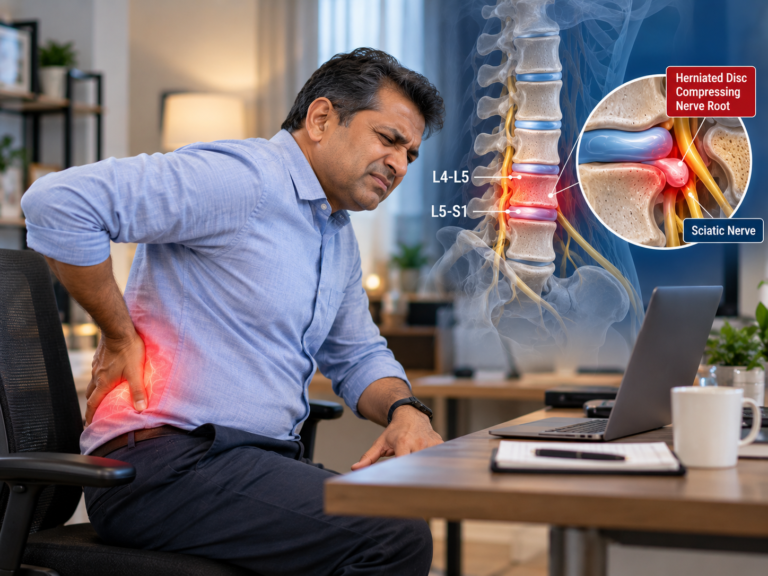

"Doctor, I have this pain that starts in my lower back and goes all the way down to my foot." I hear this sentence at least ten times a day in my clinic. The story is almost always the same. The pain starts somewhere in the lower back, travels through the hip, runs down the back of the thigh, and shoots all the way to the calf or foot. Some patients say it feels like an electric shock. Others describe it as a hot wire running through their leg.
This is sciatica. And if you are reading this, chances are you or someone close to you is dealing with it right now.
Sciatica is one of the most common reasons patients walk into my clinic at Noida Pain Management Clinic. It is also one of the most misunderstood conditions in India. Patients are told to rest for weeks, given painkillers that barely help, and eventually told they need surgery. Most of the time, none of that is necessary.
Let me explain what sciatica actually is, why it happens, and how it can be treated properly without an operation.
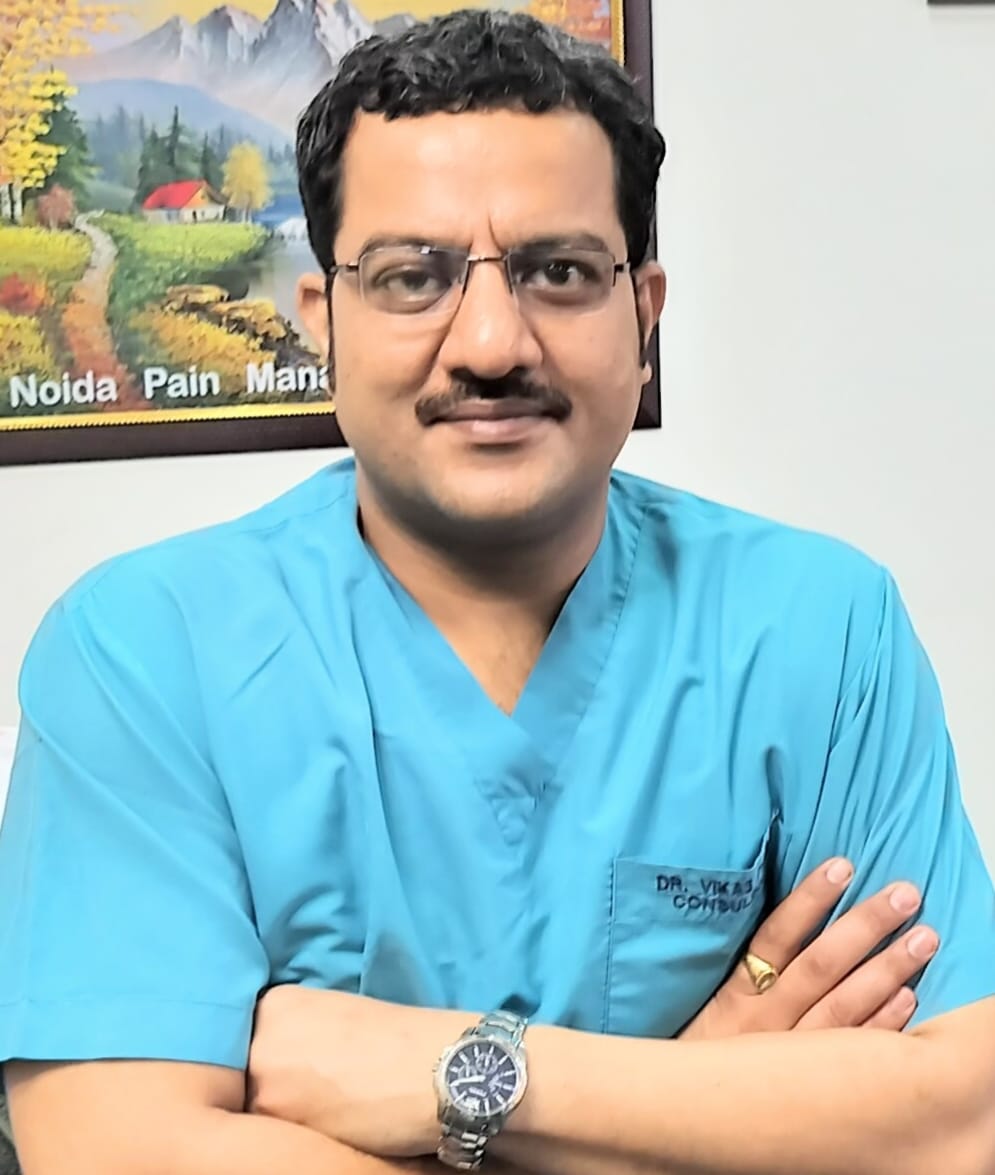
Noida Pain Management Clinic, Sector 117
- Sciatica is not a disease but a symptom of the sciatic nerve being compressed, pinched, or irritated somewhere along its path from the lower spine to the foot.
- The most common cause is a disc problem at the L4-L5 or L5-S1 level, accounting for 85 to 90 percent of cases. Other causes include lumbar spondylosis and piriformis syndrome.
- Pain that travels below the knee, numbness, tingling, or weakness are signs that a nerve is compressed and needs specialist evaluation.
- Over 90 percent of sciatica cases can be treated without surgery using nerve root blocks, caudal epidural injections, ozone therapy, medicines, and exercises.
- Warning signs like foot drop or loss of bladder or bowel control require immediate medical attention.
- Early treatment prevents nerve damage and gives much better outcomes than waiting for months.
What Is Sciatica: Why the Pain Travels From Back to Foot
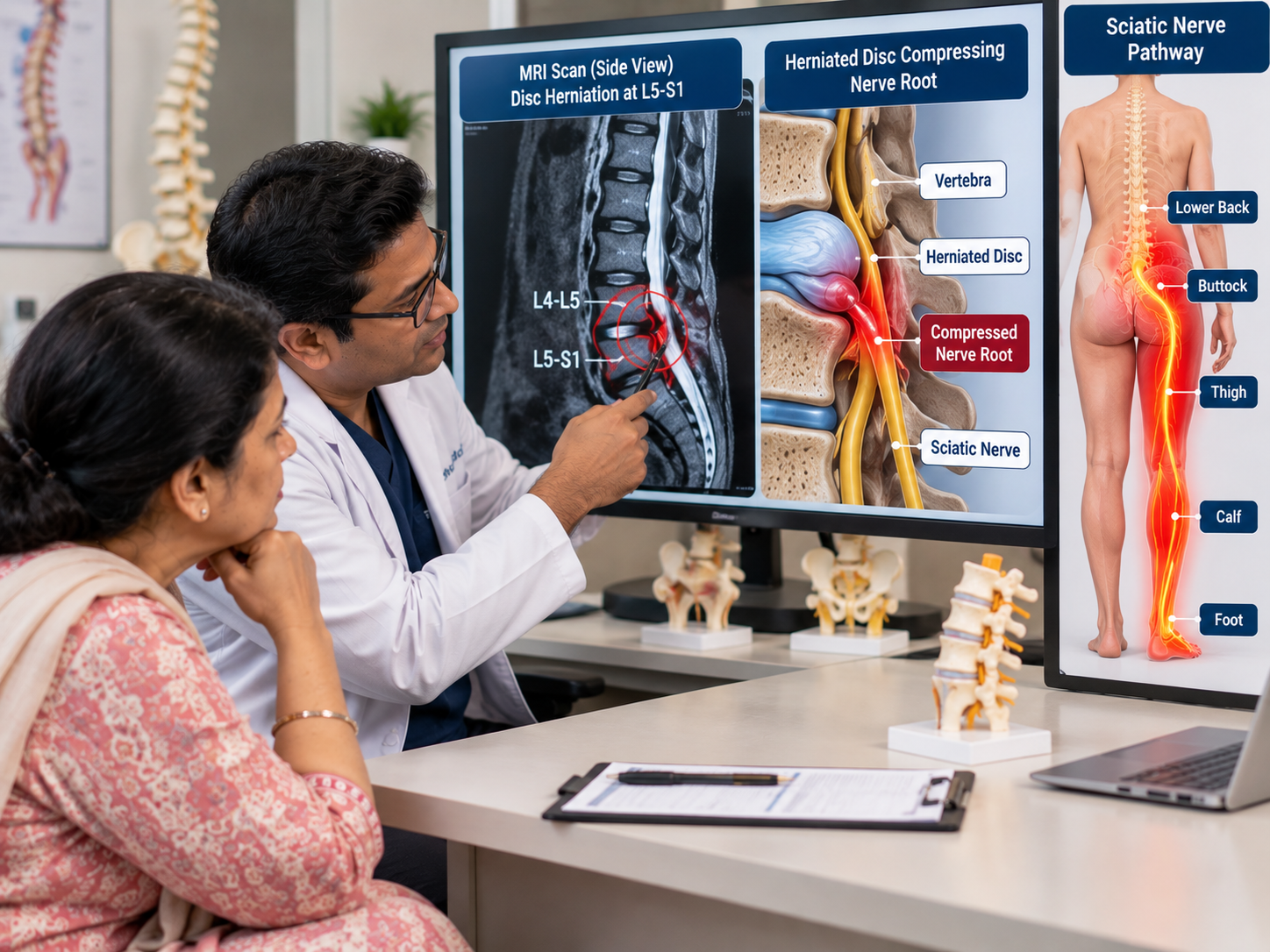
Sciatica is not a disease. It is a symptom. It tells us that the sciatic nerve, which is the longest and thickest nerve in the human body, is being compressed, pinched, or irritated somewhere along its path.
The sciatic nerve starts from the lower spine (from the nerve roots at L4, L5, S1, S2 and S3 levels), passes through the buttock, runs down the back of the thigh, and splits below the knee into branches that go to the calf, ankle, and foot. When this nerve is pressed at any point along this path, you feel pain, numbness, tingling, or weakness along the areas it supplies.
That is why sciatica pain does not stay in the back. It travels. The pain follows the nerve.
How the Sciatic Nerve Gets Compressed
The most common place where the sciatic nerve gets compressed is in the lower spine. This happens when:
- A disc bulges or herniates and presses on the nerve root (this is the most common cause by far)
- The spinal canal narrows and squeezes the nerve (spinal stenosis)
- A bone spur grows and pushes into the nerve space
- The piriformis muscle in the buttock tightens and presses on the nerve (piriformis syndrome)
In about 85 to 90 percent of sciatica cases, the culprit is a disc problem at the L4-L5 or L5-S1 level. This is important to know because the treatment depends entirely on what is causing the compression.
Sciatica vs Normal Back Pain: How to Tell the Difference
Many patients are confused about whether they have sciatica or just regular back pain. Here is a simple way to tell:
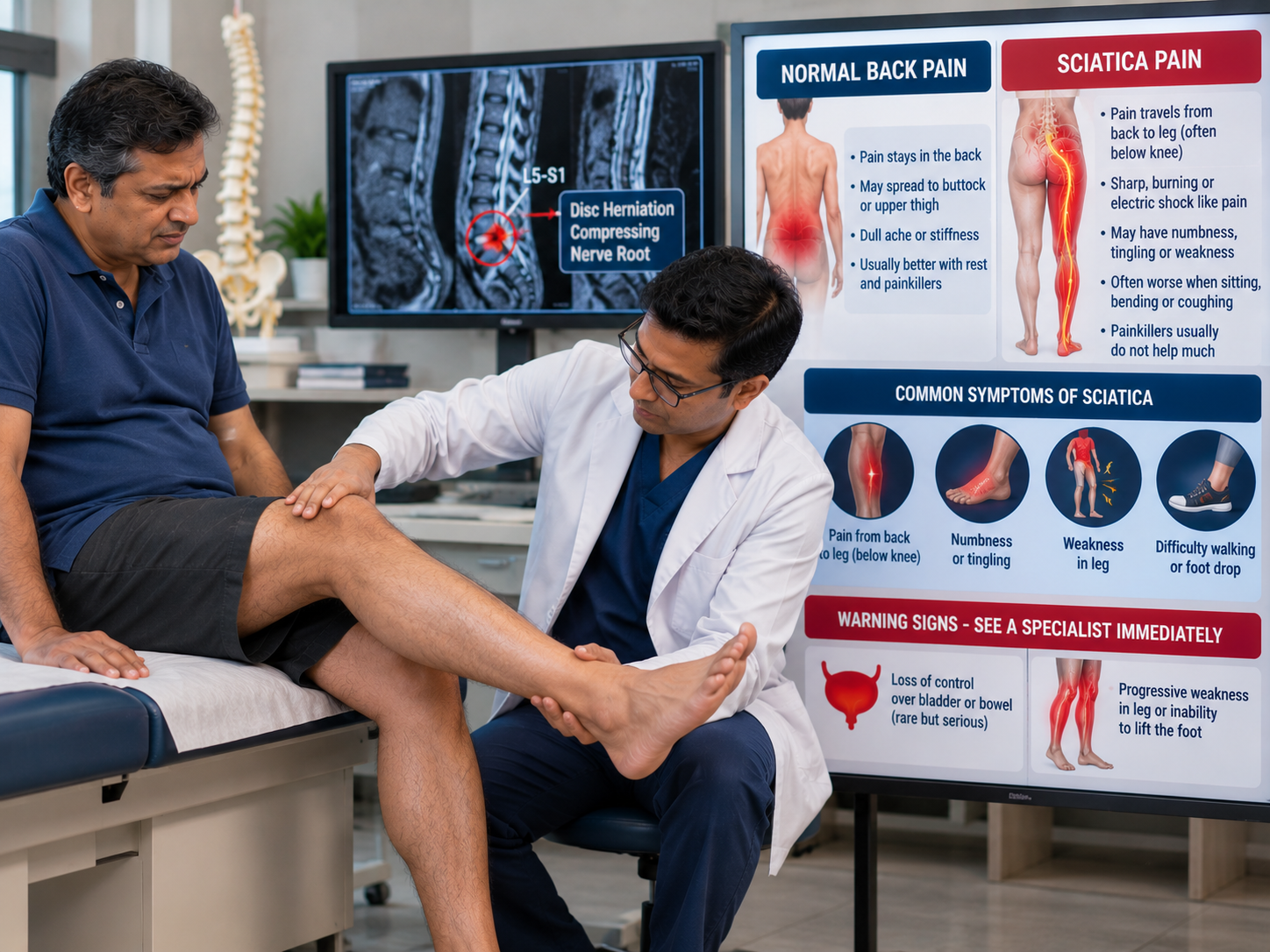
Normal back pain stays in the back. It might spread to the buttock or the upper thigh, but it does not travel below the knee. It usually feels like a dull ache, muscle tightness, or stiffness. It gets better with rest and over-the-counter painkillers.
Sciatica travels. The pain goes from the lower back or buttock and shoots down the leg, often below the knee and sometimes all the way to the foot. It feels sharp, burning, or like an electric shock. It may come with numbness, tingling, or weakness in the leg. It often gets worse when you sit, bend forward, or cough. Simple painkillers usually do not help much.
If your pain is going below the knee, that is a strong sign that a nerve is being compressed and you should see a specialist rather than continuing with painkillers alone.
Most Common Causes of Sciatica in India
Slipped Disc (Disc Herniation)
This is the number one cause of sciatica. When the soft center of a spinal disc pushes out through a weak spot in the outer ring and presses on the nearby nerve root, you get classic sciatica symptoms.
The L4-L5 and L5-S1 discs are the most commonly affected because they bear the maximum load of your body weight and are involved in almost every bending and twisting movement.
In India, disc problems are becoming increasingly common even in younger people. Prolonged sitting, poor posture, obesity, and lack of exercise are the main reasons. I regularly see patients in their 30s with significant disc herniations that would have been rare in that age group twenty years ago.
Lumbar Spondylosis
As you age, the spine undergoes wear and tear. The discs lose water content and become thinner. The joints develop small bone spurs. The ligaments thicken. All of this can narrow the spaces through which the nerves pass, gradually compressing the sciatic nerve roots.
Lumbar spondylosis is very common after the age of 50 in India. Many patients have it without knowing because the changes happen slowly. The symptoms often start as occasional stiffness and gradually progress to persistent pain that radiates down the leg.
Piriformis Syndrome
The piriformis is a small muscle deep in the buttock. The sciatic nerve passes right underneath this muscle (and in about 15 to 20 percent of people, the nerve actually passes through the muscle). When the piriformis gets tight or goes into spasm, it can squeeze the sciatic nerve and cause pain that feels exactly like disc-related sciatica.
Piriformis syndrome is commonly seen in people who sit for long hours, especially on hard surfaces. It is also common in runners and people who suddenly increase their physical activity. The key difference is that piriformis syndrome causes pain mostly in the buttock and back of the thigh, and the MRI of the spine usually looks normal.
This condition is frequently missed because most doctors only look at the spine when a patient complains of sciatica. If the spine MRI is normal but you still have shooting leg pain, piriformis syndrome should be considered.
7 Signs Your Sciatica Needs a Specialist
Not every episode of leg pain needs a specialist. Sometimes sciatica is mild and settles on its own within a few days. But there are certain warning signs that mean you should see a pain management specialist without delay:
- Pain that has lasted more than 4 weeks despite rest and painkillers
- Pain that is getting progressively worse rather than improving
- Numbness or tingling in your leg, foot, or toes
- Weakness in your leg or foot making it difficult to walk or lift your foot (this is called foot drop and it needs urgent attention)
- Pain that wakes you up from sleep consistently
- Difficulty sitting for even short periods because of shooting leg pain
- Any loss of bladder or bowel control (this is a medical emergency and requires immediate hospital care)
- You have progressive weakness in the leg or foot, or difficulty lifting your foot while walking (foot drop)
- You experience any loss of bladder or bowel control — this is a medical emergency
- Numbness is spreading or pain is getting worse despite treatment
- Pain has lasted more than 4 weeks despite rest and painkillers
Proven Non-Surgical Treatments for Sciatica
Here is the good news. Over 90 percent of sciatica cases can be treated without surgery. The key is getting the right treatment at the right time from the right specialist.
These are the treatments I use daily in my practice and the ones that give consistent, lasting results.
Nerve Root Block Injection
This is one of the most precise and effective treatments for sciatica. Here is how it works.
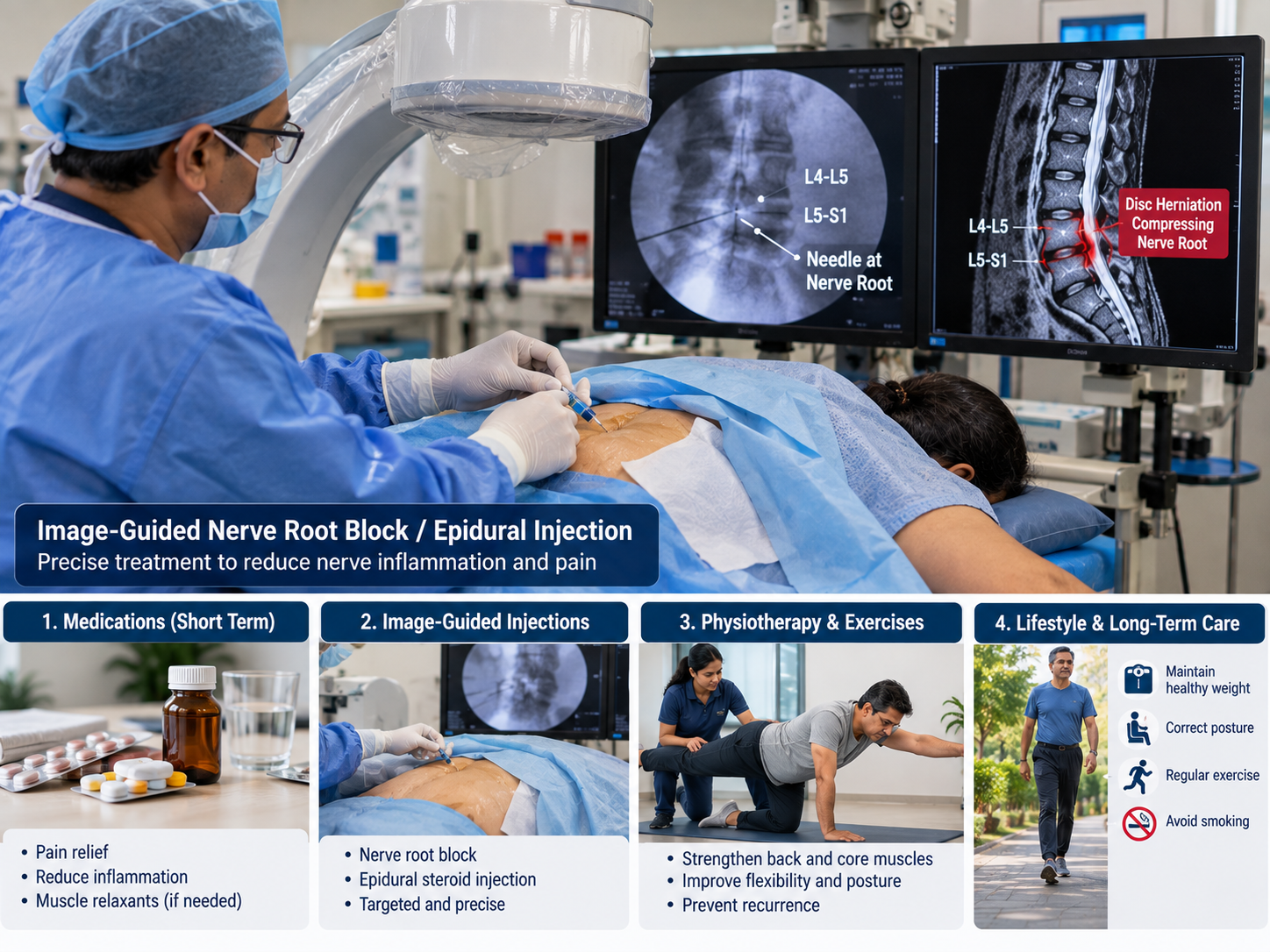
Using fluoroscopy (live X-ray guidance), I identify the exact nerve root that is being compressed. Then I place a thin needle right next to that specific nerve and inject a combination of a local anaesthetic and anti-inflammatory steroid. The medicine bathes the irritated nerve, reduces the swelling around it, and interrupts the pain signal.
The entire procedure takes 30 to 40 minutes. You are awake the entire time. There is no cut, no stitch, no general anaesthesia. You rest for about 30 minutes after the procedure and go home the same day.
Most patients begin to feel significant relief within 2 to 3 days. The success rate is very good for properly selected patients.
Dr. Vikas Tyagi offers advanced non-surgical sciatica treatment at Noida Pain Management Clinic. Same-day appointments available.
Caudal Epidural Injection
A caudal epidural is another approach to delivering anti-inflammatory medicine to the area around the spinal nerves. Instead of going through the back, the needle is inserted through the sacral hiatus (a small opening at the base of the spine near the tailbone).
This approach is particularly useful when multiple nerve roots are affected, or when the disc problem is at the L5-S1 level. It is a very safe procedure with minimal discomfort.
The advantage of the caudal approach is that the medicine spreads more widely, covering a larger area. This makes it useful when the exact level of compression is not entirely clear, or when there are disc problems at more than one level.
Ozone Therapy for Disc Compression
Ozone therapy is becoming increasingly popular in India for treating disc-related sciatica, and for good reason. It works differently from steroid injections.
I inject a precise amount of medical-grade ozone gas directly into the problematic disc using fluoroscopy guidance. The ozone reacts with the disc material and causes it to shrink. Once the disc shrinks, it stops pressing on the nerve, and the sciatica pain reduces significantly.
Think of it as deflating a balloon that is pressing against a wire. The pressure releases without having to cut anything.
Ozone therapy is especially useful for patients who have a clear disc herniation on MRI that matches their symptoms. The procedure takes about 30 minutes, requires no hospital stay, and most patients return to normal activities within 4 to 5 days.
Medicines and Exercises
Most patients with sciatica do well on a short course of medicines that include anti-inflammatory drugs, nerve pain medications, and muscle relaxants. Once the acute pain settles, a structured exercise programme focusing on core strengthening and flexibility helps prevent recurrence.
I always tell my patients that medicines control the symptoms while the body heals. They are rarely the complete solution by themselves, but they are an important first step. About 70 percent of patients with mild to moderate sciatica improve significantly with proper medication and guided exercises alone.
How Long Until Sciatica Is Gone?
This is probably the question I hear most often. Patients want to know when they will be normal again, and they deserve an honest answer.
Mild sciatica (pain without significant numbness or weakness): With proper medication and care, mild sciatica often improves within 2 to 6 weeks. The pain gradually decreases and most patients can return to normal activities within this period.
Moderate sciatica (significant pain, some numbness): If medicines alone are not enough, an interventional procedure like a nerve root block or epidural injection usually gives significant relief within 3 to 7 days. Full improvement typically happens over 3 to 4 weeks.
Severe sciatica (intense pain, weakness, or foot drop): These cases need urgent evaluation. If there is progressive neurological weakness, surgery may need to be considered.
One thing I want to be very clear about: sciatica that has been present for months without proper treatment takes longer to resolve than sciatica that is treated early. If you have been suffering for six months and expecting overnight results, that is not realistic. But significant improvement within weeks is absolutely achievable with the right approach.
Why Patients From Delhi NCR Choose NPMC Noida
Noida Pain Management Clinic is located in Sector 117, Noida. We are a dedicated chronic pain management centre, not a multi-specialty hospital. Every patient who walks through our door is here for one reason: pain. And everything we do is focused on solving that problem.
Here is why patients travel from across Delhi, Ghaziabad, Greater Noida, Faridabad, and the entire NCR region to see us:
Accurate diagnosis: I do not just look at the MRI and decide. I examine every patient thoroughly to understand which nerve is affected, what is causing the compression, and whether the MRI findings match the clinical picture. This is the step that most clinics skip, and it is the step that makes the biggest difference.
Non-surgical treatment that works: We offer a full range of interventional procedures including fluoroscopy-guided nerve root blocks, epidural injections, ozone therapy, and PRP therapy. These are not experimental treatments. They are evidence-based procedures that I have performed thousands of times with consistently good results.
Same-day appointments: When you are in pain, waiting for a week to see a doctor is not acceptable. Call us or WhatsApp us, and we will confirm your appointment within minutes.
Honest advice: If I believe your case genuinely needs surgery, I will tell you directly and refer you to a trusted surgeon. I will never keep treating you with injections if surgery is what you actually need. But if non-surgical treatment can help you, which it does in the vast majority of cases, that is what I will recommend.
Dr. Vikas Tyagi offers advanced non-surgical sciatica treatment at Noida Pain Management Clinic. Get relief without an operation.
FAQs: Sciatica Treatment
Can sciatica be permanently cured without surgery?
How do I know if my sciatica is serious?
What is the difference between a nerve root block and an epidural injection?
Does sciatica come back after treatment?
Is walking good for sciatica?
Can sciatica cause permanent nerve damage?
How much does sciatica treatment cost at your clinic?
Medical disclaimer: This article is for general information only and is not a substitute for a medical consultation. Treatment depends on each patient's condition. Please consult a qualified doctor before starting any treatment.