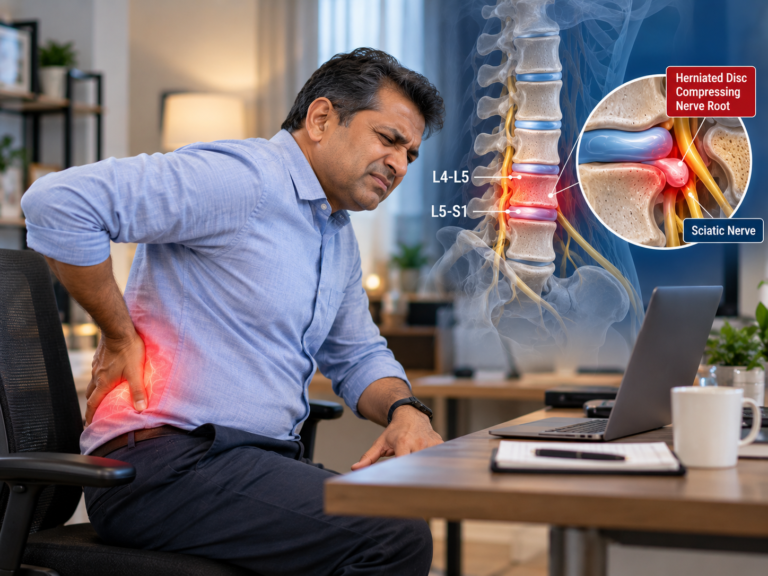

If I were to pick one condition that defines modern India's working population, it would be neck pain. Not heart disease. Not diabetes but Neck pain.
I say this because of what I see every day in my practice. Young professionals in their 30s coming in with neck pain so severe that they cannot turn their head without wincing. IT engineers who have developed disc problems at C5-C6 that you would normally expect to see in someone 20 years older. People who have had headaches every single day for months and do not realise the headaches are coming from their neck.
Cervical spondylosis has become the occupational disease of the Indian IT and service industry. And the work-from-home culture that started a few years ago has made it dramatically worse.
The good news is that cervical problems respond very well to treatment when diagnosed correctly. The bad news is that most people ignore the early warning signs until the condition has progressed to a point where simple solutions no longer work.

Noida Pain Management Clinic, Sector 117
- Cervical spondylosis has become the occupational disease of Indian IT and service industry workers, made worse by poor work-from-home setups.
- Forward head posture dramatically increases the load on neck muscles—at 2 to 3 inches forward, your neck handles 12 to 15 kg instead of 5 kg.
- The most commonly affected cervical discs are C5-C6 and C6-C7, causing pain, numbness, and tingling in the arm and hand.
- Symptoms beyond neck pain include arm pain, numbness, weakness, and cervicogenic headaches that are often misdiagnosed as migraines.
- Non-surgical treatments include cervical epidural steroid injections, selective nerve root blocks, and PRP for disc degeneration.
- Correct workstation setup and posture correction are essential to prevent recurrence.
Why Cervical Pain Has Become an Epidemic Among Desk Workers in India
Forward Head Posture and Screen Addiction
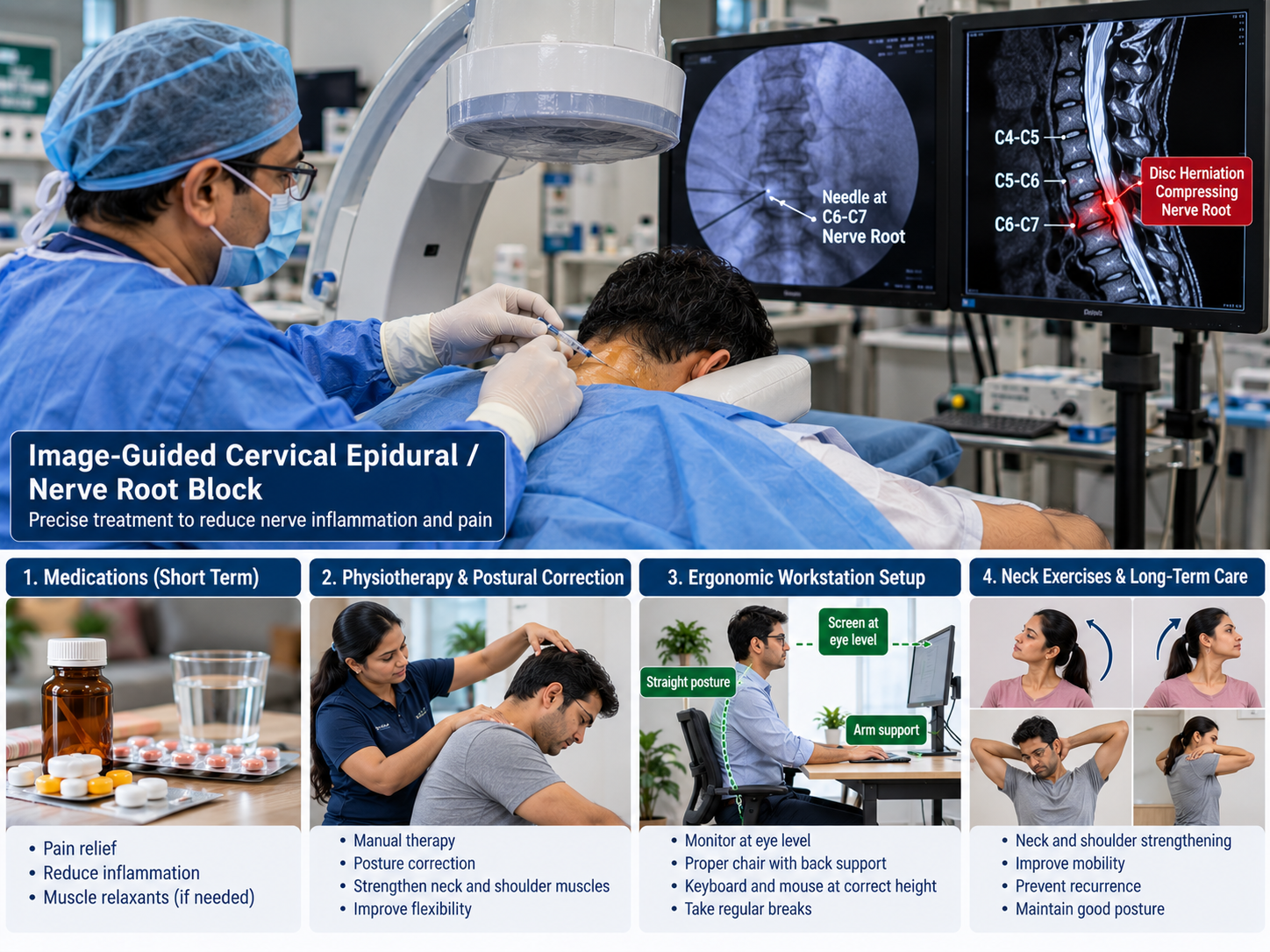
Your head weighs approximately 4.5 to 5 kg. When your head is directly above your shoulders in proper alignment, your neck muscles handle this weight easily. But for every inch your head moves forward (which is exactly what happens when you lean towards a screen), the effective weight on your neck muscles doubles.
At a typical desk posture where the head is 2 to 3 inches forward, your neck muscles are handling 12 to 15 kg of load instead of 5 kg. Do this for 8 to 10 hours a day, 5 to 6 days a week, for years, and you have a recipe for cervical disc degeneration, muscle fatigue, and chronic pain.
This is not theoretical. I can often tell within the first minute of seeing a patient whether they work at a desk. The forward head posture, the rounded shoulders, the tightness in the upper trapezius muscles are all telltale signs.
And it is not just computers. Smartphones have made it worse. The angle at which people look down at their phones puts even more stress on the cervical spine than looking at a computer screen. Some researchers have started calling this "text neck," and it is showing up in people as young as their early 20s.
Work From Home Setup: The Biggest Culprit
When offices shifted to work-from-home during the pandemic, most people did not set up a proper workstation. They worked from their bed, their sofa, their dining table, or a small desk with a laptop placed directly on the surface.
A laptop on a flat table is one of the worst possible setups for your neck. The screen is too low, forcing your head to tilt forward and downward. The keyboard is attached to the screen, so you cannot adjust them independently. And because you are at home, there is no one to remind you to take breaks or maintain posture.
I saw a noticeable spike in cervical pain cases starting about 6 months after the work-from-home shift began. Many of these patients had never had neck problems before. The setup was entirely to blame.
Even now, years later, many people continue to work from home at least part of the week, and most still have not fixed their workstation ergonomics.
Understanding Cervical Spondylosis: What Is Actually Happening in Your Neck
Cervical spondylosis is a broad term for age-related and wear-related changes in the cervical spine (the neck portion of the spine, made up of 7 vertebrae labeled C1 through C7).
Disc Degeneration at C5-C6, C6-C7
The cervical discs, just like the lumbar discs in the lower back, act as shock absorbers between the vertebrae. Over time, and especially with the mechanical stress of poor posture, these discs lose their water content, become thinner, and may bulge or herniate.
The two most commonly affected levels in the neck are:
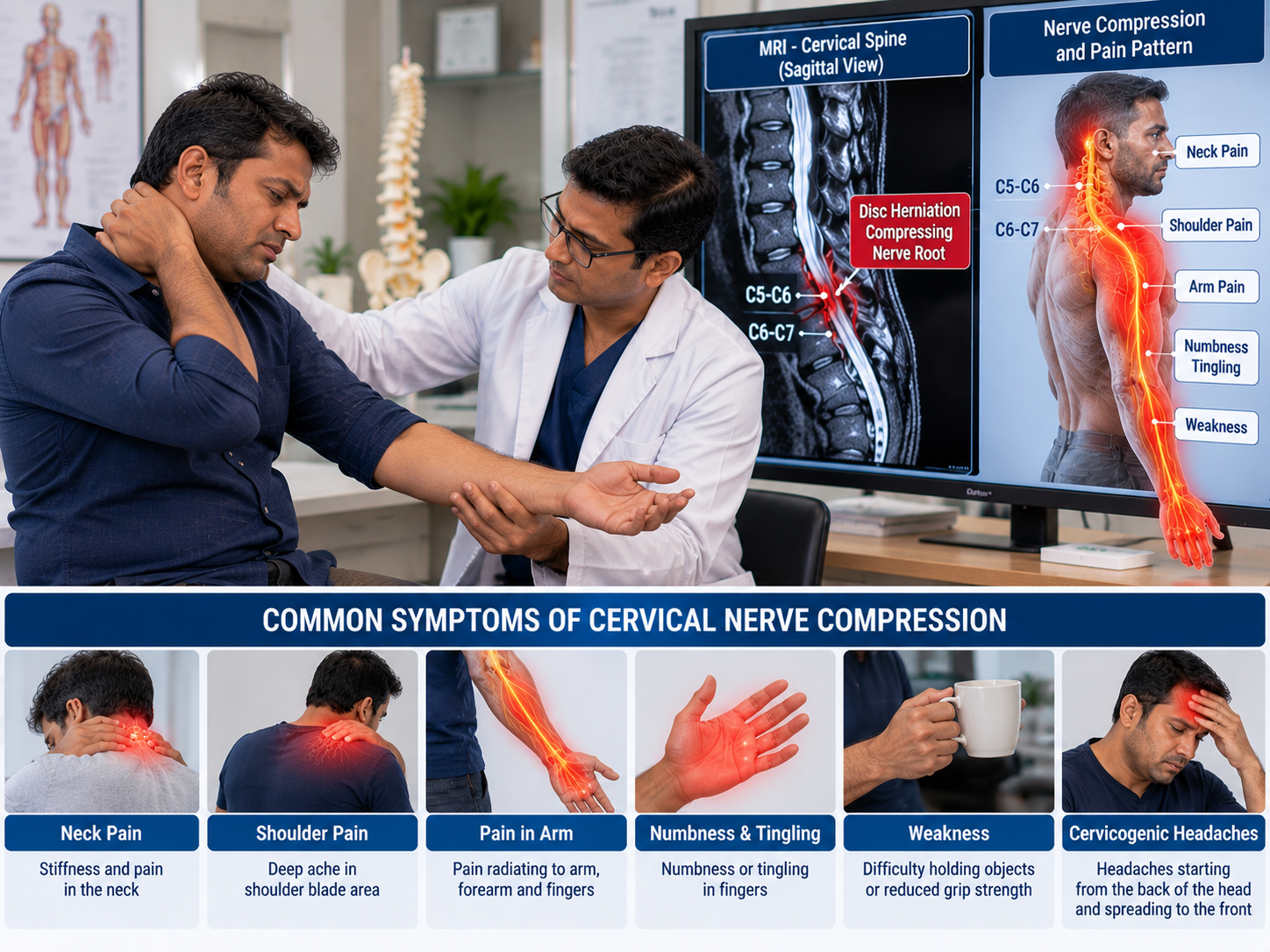
C5-C6: This is the most frequently affected cervical disc. Problems here cause pain in the neck, shoulder, outer arm, and sometimes the thumb and index finger. Many patients describe a deep ache in the shoulder blade area along with neck stiffness.
C6-C7: This is the second most common level. Issues here cause pain that radiates to the back of the arm, the middle finger, and sometimes the ring finger. Patients often notice weakness when trying to extend the wrist or push against resistance.
In desk workers, disc problems at these levels are appearing at increasingly younger ages. I have treated IT professionals in their early 30s with significant disc herniations at C5-C6 that were directly caused by years of poor posture.
Bone Spurs and Nerve Compression
As the discs thin out, the vertebrae come closer together. The body responds by forming small bony growths called osteophytes (bone spurs) at the edges of the vertebrae. These bone spurs can narrow the spaces through which the nerves pass, causing nerve compression.
When a cervical nerve is compressed, you do not just feel pain in the neck. You feel it along the entire path of that nerve, which typically runs from the neck through the shoulder and down the arm to the hand. This is called cervical radiculopathy, and it is one of the most common reasons patients come to my clinic.
Symptoms Beyond Neck Pain: Do Not Ignore These
Most people think cervical spondylosis means neck pain and stiffness. That is only part of the picture. There are several symptoms that people do not associate with the neck but that are directly caused by cervical problems.
Arm Pain, Numbness, Tingling
If your neck problem is compressing a nerve, you will feel symptoms in your arm and hand, not just your neck. This can include:
- A shooting or burning pain from the neck through the shoulder and down the arm
- Numbness or tingling in specific fingers (which fingers are affected depends on which nerve is compressed)
- Weakness in the arm or hand, making it difficult to grip objects or type
- A feeling of heaviness in one arm
Many patients come to me thinking they have a shoulder problem or a hand problem when the actual source is in the neck. A thorough examination and sometimes an MRI of the cervical spine reveals the true cause.
Headaches Starting From the Neck
This is one of the most underdiagnosed conditions I see. Cervicogenic headaches are headaches that originate from the neck. They are commonly mistaken for migraines or tension headaches, and patients end up taking migraine medications that do not work because the real problem is in the neck.
Cervicogenic headaches typically start at the back of the head or the base of the skull and spread forward. They are usually one-sided. They are made worse by certain neck positions or movements. And they are often accompanied by neck stiffness.
If you have been getting frequent headaches and you also have neck pain or stiffness, there is a good chance the headaches are cervicogenic. Treating the neck problem often resolves the headaches completely.
Treatment Options: From Physiotherapy to Injections
Medicines and Physiotherapy
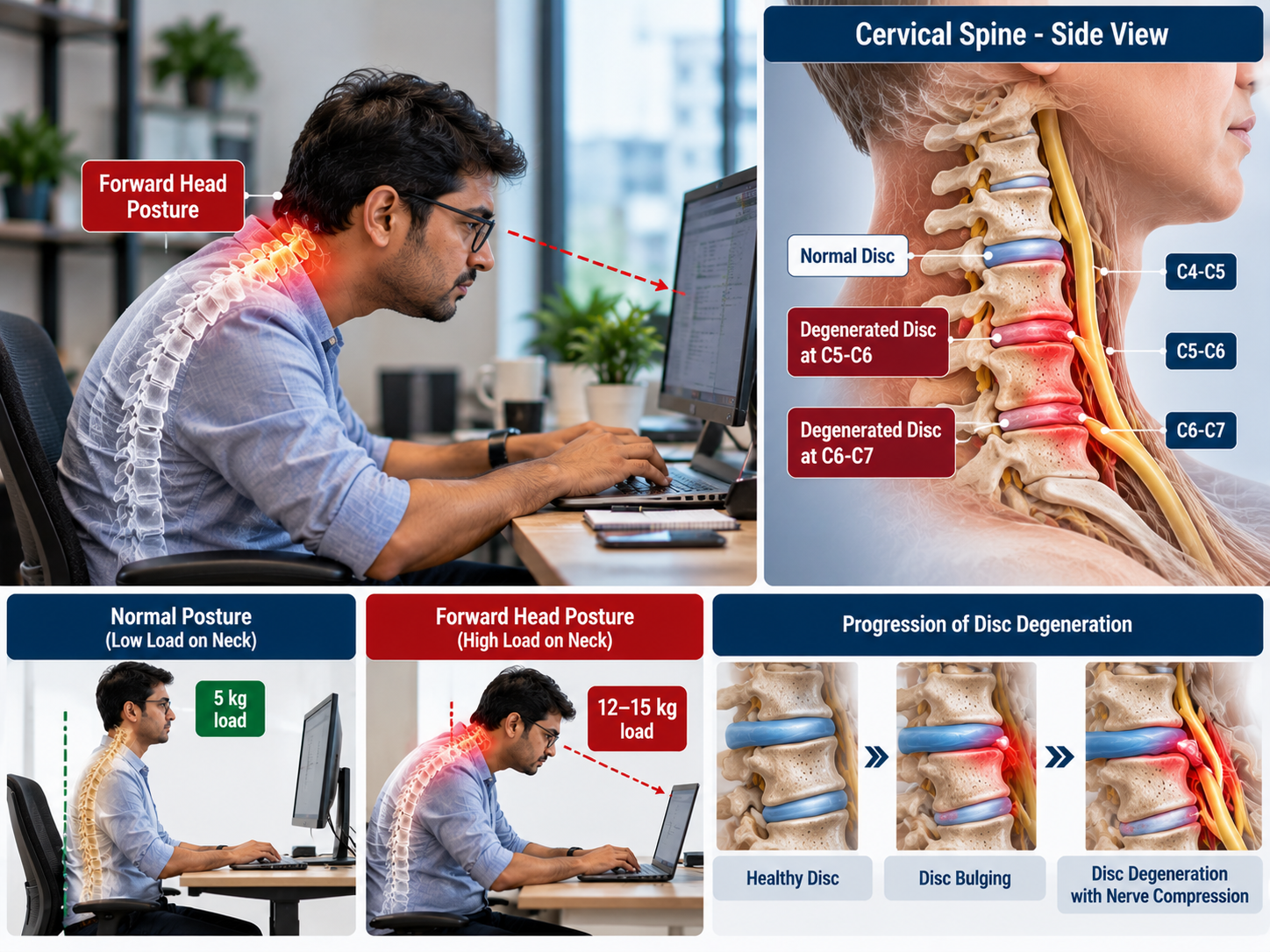
For mild cervical pain without nerve compression, a combination of anti-inflammatory medicines, muscle relaxants, nerve pain medication (if there is arm pain), and structured physiotherapy is often enough.
The physiotherapy should focus on neck strengthening, postural correction, and gentle stretching. Aggressive manipulation of the neck (the kind where someone "cracks" your neck) should be avoided. I have seen cases where aggressive neck manipulation has worsened disc herniations and caused nerve damage.
Cervical Epidural and Nerve Root Block
When medicines and physiotherapy are not enough, or when there is significant nerve compression causing arm pain, numbness, or weakness, interventional treatments become necessary.
Cervical epidural steroid injection: I inject anti-inflammatory medicine into the epidural space in the cervical spine using fluoroscopy guidance. This reduces the swelling around the compressed nerves and provides significant pain relief. The procedure takes about 30 minutes, is done under local anaesthesia, and does not require hospital admission.
Selective nerve root block: When I can identify the specific nerve root that is being compressed (for example, the C6 nerve root), I can deliver medicine directly to that nerve using a targeted injection. This is more precise than an epidural and works especially well when a single nerve root is the clear source of pain.
Both procedures are safe when performed by an experienced pain specialist using proper imaging guidance. The results are usually excellent, with most patients experiencing significant improvement within a few days.
Dr. Vikas Tyagi offers advanced non-surgical cervical spondylosis treatment at Noida Pain Management Clinic. Same-day appointments available.
PRP for Disc Degeneration
PRP therapy is also showing promising results for cervical disc degeneration. The growth factors in PRP can help reduce inflammation within the degenerated disc and improve the quality of the surrounding tissues. While PRP cannot reverse disc degeneration, it can slow the progression and provide symptom relief that lasts months.
I use PRP for cervical conditions selectively, usually in patients with early to moderate disc degeneration who want to avoid or delay more invasive procedures.
Correct Workstation Setup to Prevent Relapse
Treatment is only half the battle. If you go back to the same workstation setup that caused the problem, the pain will come back. Here is a practical guide to setting up a spine-safe workstation.
Monitor height: The top of your screen should be at eye level. If you use a laptop, get a separate keyboard and mouse and place the laptop on a stand or stack of books to raise the screen.
Monitor distance: The screen should be approximately one arm's length away. Too close and you hunch forward. Too far and you lean forward to read.
Chair: Your chair should have good lumbar support and the seat height should be adjusted so your feet are flat on the floor and your thighs are parallel to the ground. Arm rests should allow your elbows to rest at 90 degrees.
Keyboard and mouse: These should be at a height where your elbows are at 90 degrees and your wrists are in a neutral position, not bent up or down.
Breaks: Take a 30-second neck stretch break every 30 minutes. Stand up and walk for 2 minutes every hour. Set a timer on your phone if you tend to forget.
Phone usage: Hold your phone at eye level instead of looking down at it. Use voice-to-text when possible. Limit phone screen time outside of work.
These changes seem small, but they make an enormous difference over time. The same posture habits that caused the problem over years can be reversed with consistent correction over months.
Treatment at Noida Pain Management Clinic
At our clinic in Sector 117, Noida, cervical pain is one of our most frequently treated conditions. We see patients from the IT corridors of Noida and Gurgaon, from the corporate offices of Delhi, and from across the NCR region.
Our approach is to first understand the exact cause of your cervical problem through clinical examination and imaging, then start with the least invasive treatment that is likely to work, and escalate only if necessary.
Every injection is done under fluoroscopy or ultrasound guidance. We offer same-day appointments. And we take the time to educate every patient about workstation ergonomics and exercises, because preventing recurrence is just as important as treating the current episode.
Dr. Vikas Tyagi offers advanced non-surgical treatment for cervical spondylosis at Noida Pain Management Clinic. Get back to pain-free living.
FAQs: Cervical Treatment
Can cervical spondylosis be completely cured?
Is it safe to exercise with cervical spondylosis?
Can neck pain cause headaches?
How long does cervical treatment take to show results?
Is cervical spondylosis common in young people?
Do I need surgery for cervical disc herniation?
Medical disclaimer: This article is for general information only and is not a substitute for a medical consultation. Treatment depends on each patient's condition. Please consult a qualified doctor before starting any treatment.