

Back Pain in IT Professionals: Why Software Engineers and Desk Workers Are Destroying Their Spine and How to Fix It

In my clinic, I see software engineers every week who are surprised by one thing: they have not lifted anything heavy, met with an accident or done hard physical labour, yet their back pain is severe enough to disturb work and sleep. Their real injury has usually happened slowly, one working day at a time.
A developer sits through morning stand up calls, coding reviews, production issues and late night deployments. A support engineer works in a small PG room with a laptop on the bed. A manager spends the day moving from one video call to another, then sits again in a cab or metro. By evening, the neck is stiff, the lower back feels locked and the shoulders ache.
The good news is that desk related back pain can often be controlled when the cause is found early. The problem begins when every episode is treated as simple tiredness and the same posture is repeated for years.

Noida Pain Management Clinic, Sector 117
Why India's Tech Boom Is Creating a Back Pain Epidemic
India's technology workforce is young and used to solving difficult problems under pressure. The body, however, responds only to load, posture, rest and recovery. Long hours in one position make the spine pay quietly.
8 to 12 Hours of Sitting = Slow Spine Damage
Sitting is not poisonous by itself. The problem is sitting for long periods without changing position, especially in a slouched posture. When you sit, pressure inside the spinal discs changes and the lower back loses some of its natural support. If you lean forward towards the screen, that load increases further.
Your discs also depend on movement. They do not have the same rich direct blood supply as many other tissues. Movement during walking and standing helps fluid and nutrients move in and out. When you remain still for hours, this natural exchange slows down. Over time, a poorly nourished disc becomes less resilient and more vulnerable to strain.
The muscles suffer too. The gluteal muscles and deep core muscles do very little while you sit, so they gradually become less active and weaker. The hip flexors become tight, the back muscles stay switched on for too long, and simple tasks like standing straight or climbing stairs begin to feel tiring. Add a long commute before and after office, and the back gets almost no real recovery during the day.
Why WFH Made Everything Worse
Work from home removed the commute for some people, but it also removed the small movements built into office life: walking to a meeting room, going for chai, visiting a colleague's desk or climbing stairs to the cafeteria. At home, many people work from a bed, sofa, floor cushion or dining chair. In a hostel or PG, the desk may be tiny and the chair may have no back support at all.
The laptop is another major problem. Its screen and keyboard are joined together. If the keyboard is comfortable, the screen is too low. If the screen is raised, the keyboard becomes too high unless separate accessories are used. Many professionals also work longer at home because the boundary between office and personal time disappears. A quick call becomes a midnight deployment, and the spine never gets the pause it needs.
Most Common Spine Conditions in Desk Workers
Not all desk pain is a slipped disc. In my clinic, careful examination often shows a combination of muscle pain, joint irritation, disc problems and nerve involvement. Correct treatment depends on separating one from the other.
Myofascial Pain and Trigger Points
Myofascial pain comes from overloaded muscles and the connective tissue around them. Within the muscle, a small tight area called a trigger point can develop. Pressing it may reproduce the same pain the patient feels during work.
In IT professionals, I commonly find trigger points between the shoulder blades, in the neck and shoulder muscles, around the lower back and in the gluteal region. The pain is usually aching, heavy or burning. It may spread to a nearby area, but it does not always follow a nerve pattern. Stress, poor sleep, long static posture and weak supporting muscles make these points more sensitive.
A normal MRI may not show this muscle problem clearly, but the pain is real and needs targeted treatment, posture correction and exercise.
Cervical and Lumbar Spondylosis
Spondylosis is a broad term for wear related changes in the spine. Discs lose height, facet joints become irritated and small bony changes may develop near the joints. In desk workers, the neck and lower back are the two areas under constant postural stress.
Forward head posture is a major factor in the neck. As the head drifts in front of the shoulders, the neck muscles must work much harder to hold it. Even a modest forward shift makes the head feel far heavier to those muscles. The result can be neck stiffness, pain between the shoulders and headaches that begin at the back of the head.
In the lower back, repeated slouching and weak core support can make worn discs and joints painful. Spondylosis on a report does not automatically mean severe disease; many people have such changes without pain. I treat the person and examination findings, not the report alone.
Disc Herniation From Poor Posture
A disc can bulge or herniate when its outer covering weakens and the inner material pushes outward. Long periods of slouched sitting do not usually cause a major herniation in one day, but they can stress an already vulnerable disc. A sudden bend, twist, cough or attempt to lift a heavy bag in poor posture may then trigger symptoms.
In the lower back, a herniated disc can irritate a nerve going into the leg. The patient may feel pain, tingling or numbness travelling below the knee. In the neck, a disc problem can send symptoms into the shoulder, arm or hand. This pattern is different from local muscle pain and needs a proper neurological examination.
Warning Signs You Are Ignoring at Your Desk
Do not dismiss pain because it improves after a weekend. I become concerned when it returns every working day, takes longer to settle, or makes sitting through a meeting difficult. Other warning signs include:
- Pain that keeps returning over several weeks
- Pain travelling into the buttock, leg, shoulder, arm or hand
- Tingling, pins and needles, or numbness
- A need to keep shifting position during calls
- Pain that disturbs sleep or makes it hard to stand straight after work
- Increasing dependence on painkillers just to finish the day
There are also things you should not do. Do not take complete bed rest for days unless a doctor has advised it for a specific reason. Do not allow random forceful massage or twisting when a slipped disc is suspected. Do not start steroids or strong pain medicines on a colleague's prescription. Most importantly, do not ignore weakness that is getting worse.
Red flags need urgent medical attention. See a doctor urgently if you develop weakness in a leg or foot, loss of bladder or bowel control, numbness around the saddle area, severe pain after a major fall or trauma, fever with back pain, or unexplained weight loss along with persistent back pain. These symptoms can point to a serious problem that should not wait for routine treatment.
The Perfect Workstation Setup: Spine-Safe Guide
You do not need the most expensive chair or desk. You need support and movement. Small daily adjustments matter more than costly equipment used badly.
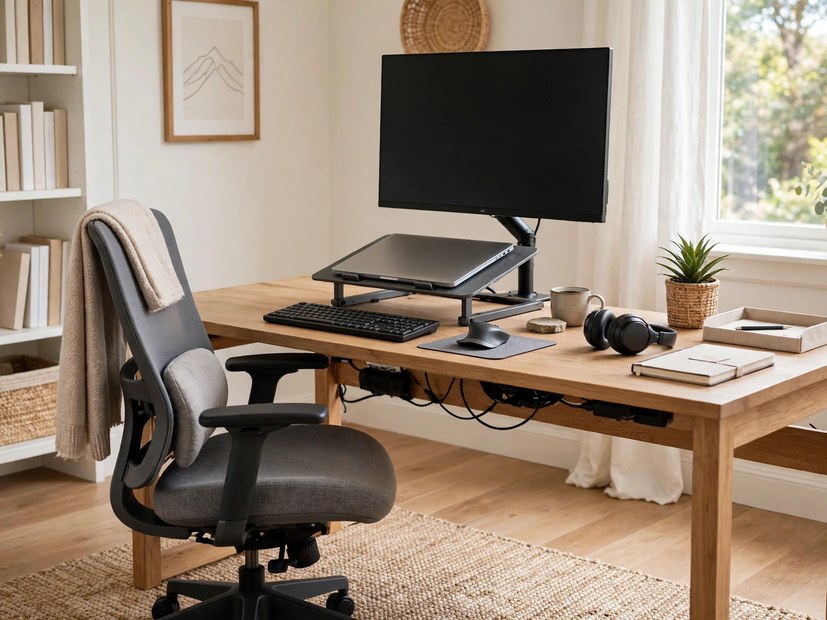
Monitor Height, Chair Adjustment, Keyboard Position
Place the screen directly in front of you, about an arm's length away. The top of the screen should be around eye level or slightly below it, so your neck stays in a neutral position. If you use a laptop, raise it on a laptop riser, stand or firm stack of books and use an external keyboard and mouse. This one change is especially important for work from home.
Your chair should support the natural curve of the lower back. Use the chair's lumbar support or a small cushion if there is a gap behind your back. Sit back in the chair rather than perching on the edge. Keep your feet flat on the floor. If your feet do not reach comfortably, use a footrest or a firm box. Your hips and knees should be comfortably positioned, and the seat should not press hard behind your knees.
Keep the keyboard and mouse close to your body. Your elbows should rest comfortably, your shoulders should stay relaxed and your wrists should remain in a neutral position rather than bending sharply. If the armrests force your shoulders upwards, lower or move them. During phone calls, avoid holding the phone between your ear and shoulder. Use earphones, a headset or speaker mode, and hold the phone closer to eye level when reading.
Movement is part of the workstation, not a separate luxury. Stand, walk or change position every 30 to 45 minutes. Once every hour, take a slightly longer break and walk, even if it is only within the room or corridor. Useful micro break movements include a gentle chin tuck, a chest opener against a door frame, a standing back extension within comfort, shoulder blade squeezes and a short walk. Stop any stretch that sends pain, numbness or weakness into an arm or leg.

Treatment When Exercises Don't Help
Exercises and ergonomic correction are the foundation, but they are not the complete answer for every patient. If pain remains severe, keeps returning or begins to involve a nerve, I first reassess the diagnosis. The painful structure may be a trigger point, a facet joint, a disc or a compressed nerve. Giving the same general treatment to all of them is a common reason for failure.
Medicines may help for a short, supervised period, but should not replace diagnosis and rehabilitation. Physiotherapy should release tight tissue, strengthen weak muscles and retrain posture, rather than only applying heat or a machine.
Trigger Point Injections
A trigger point injection is used when a painful muscle knot remains active despite medicines, stretching and physiotherapy. After examining the area and confirming that the tender point reproduces your familiar pain, I clean the skin and place a very small needle into the tight band of muscle. A small amount of local anaesthetic, and sometimes another medicine when clinically appropriate, may be injected.
You may feel a brief local twitch or a familiar ache for a moment. Mild soreness for a day or two is common. For deeper muscles, ultrasound guidance can help improve accuracy and safety. Dry needling is another technique that uses a fine needle without injecting medicine, and it may be considered in selected patients.
The injection is not a stand alone cure. It can switch off a stubborn pain source so that stretching, strengthening and workstation correction become possible again. If the same posture continues unchanged, the trigger point may return.
Nerve Block and Epidural
I consider a nerve block or epidural injection when pain travels into the leg or arm and the examination and imaging suggest that a disc is irritating or compressing a nerve. These procedures are also considered when medicines and physiotherapy have not controlled significant radiating pain.
An epidural places anti-inflammatory medicine near the affected spinal nerves to reduce irritation and swelling. A selective nerve block targets one particular nerve root more precisely and can also help confirm which nerve is responsible. These injections do not repair the disc itself. Their purpose is to calm the nerve, reduce pain and create a window in which rehabilitation can work.
Such procedures should be done in a sterile setting by a trained pain specialist, using X-ray C-arm or ultrasound guidance where relevant. Before recommending one, I explain the expected benefit, the limitations, the medicines used and the possible risks. Surgery is reserved for specific situations, such as worsening neurological weakness, certain severe structural problems or symptoms that do not improve despite appropriate non-surgical care.
How Soon Can You Return to Work After Treatment?
Most desk workers do not need long leave for treatment of back pain. After many day care injections, patients can return home the same day and resume light desk work the next day, depending on the procedure, any sedation used and how they feel. If sedation has been given, you should not drive yourself home and should follow the clinic's instructions for that day.
Returning to work does not mean returning to the same six hour sitting block. For the first few days, take shorter sitting periods, stand and walk at regular intervals, and avoid heavy lifting, sudden twisting and long drives where possible. Some temporary soreness at the injection site is common. Follow up allows exercise to progress and new numbness, weakness or unusual pain to be assessed promptly.
The goal is to return with a workstation and routine that do not recreate the problem.
Back Pain Treatment at Noida Pain Management Clinic

At Noida Pain Management Clinic, I begin with your work pattern, examination findings and the exact nature of your pain. Many IT professionals bring an MRI before anyone has examined them properly. Imaging is useful when indicated, but the first step is still a careful clinical diagnosis.
Treatment may include medicines, a structured exercise plan, trigger point treatment, or image guided injections for a disc or nerve problem. I will also discuss workstation changes, because a technically successful injection can fail if the cause remains untouched. If an injection will not help, or your condition needs a surgical opinion, I will tell you clearly.
Patients visit us from Noida, Greater Noida, Delhi, Ghaziabad and other parts of the NCR, as well as from technology centres across India when they are in the region.
Phone: +91-7428891444
WhatsApp: +91-7428891444
Location: WP 01, Sector 117, Noida, UP 201301
Back Pain That Returns Every Working Day?
Do not keep treating it as simple tiredness. Get the cause found first, then a plan for workstation, exercise and treatment that fits your work.